Watched While You Work: The Expanding Reach of Employer Surveillance Beyond the Shop Floor
The camera in the break room was pointed at the coffee maker. At least, that was the official explanation.
When a group of warehouse workers in Ohio filed a complaint with their state labor board several years ago, they alleged that the device — installed, management said, to deter theft of company property — had a field of view that encompassed the entire room, including a couch where employees on medical leave would occasionally rest during breaks, and a corner where workers frequently made private phone calls to family members.
No footage was ever produced. No disciplinary action was ever reversed. But the complaint illustrates a dynamic that labor attorneys, digital rights advocates, and workers across the country describe with increasing frequency: cameras positioned for one stated purpose that, by design or by drift, end up recording far more than their justification supports.
The Justification Architecture
American employers enjoy remarkably broad authority to surveil their workplaces. Federal law imposes few meaningful restrictions on video monitoring of employees, and the foundational legal principle — that workers in employer-owned spaces have a limited expectation of privacy — has been consistently upheld by courts.
The justifications employers most commonly invoke are loss prevention, workplace safety, and operational efficiency. These are legitimate interests, and camera systems genuinely serve them in many contexts. But they also function as a flexible framework that can be stretched to accommodate monitoring that serves very different purposes.
"Loss prevention is the gateway justification," says a labor attorney who has represented employees in workplace surveillance disputes across multiple states. "Once you've established that cameras serve a security function, the temptation to expand their coverage — and their analytical use — is significant. The law, in most states, doesn't create much friction against that expansion."
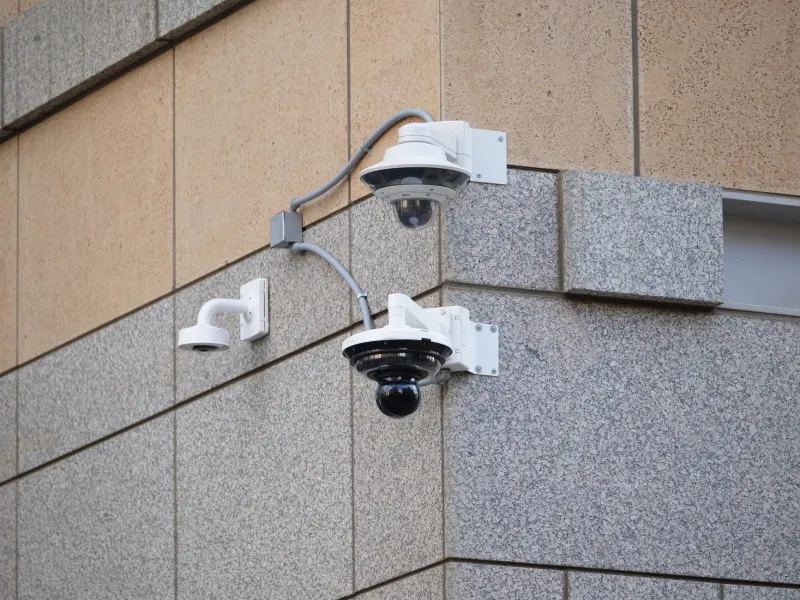
The emergence of AI-augmented camera systems has accelerated this dynamic considerably. Modern workplace cameras from vendors such as Verkada, Avigilon, and others offer capabilities that extend well beyond passive recording: emotion detection, productivity monitoring, anomaly flagging, and the ability to track individual workers' movements throughout a facility over time. These features are often bundled into systems sold primarily on a safety and security value proposition.
Where the Cameras Should Not Be — and Sometimes Are
There is one area of near-universal legal consensus: cameras in bathrooms, locker rooms, and changing areas are prohibited. Federal law under the Video Voyeurism Prevention Act addresses this in federal jurisdictions, and all fifty states have statutes that criminalize recording in spaces where individuals have a reasonable expectation of privacy for personal activities.
That consensus does not prevent violations. The Occupational Safety and Health Administration, the Equal Employment Opportunity Commission, and state labor agencies have all investigated documented cases of cameras found in workplace restrooms and changing facilities. In several high-profile cases, the devices were installed not by management acting officially but by individual supervisors or maintenance personnel — a distinction that matters for criminal liability but offers limited comfort to the workers who were recorded.
The more pervasive and legally ambiguous issue involves spaces that fall between the clearly protected and the clearly permissible. Break rooms, private offices, medical rooms, lactation spaces, and areas designated for prayer or religious observance occupy a contested middle ground.
Some states have begun to address this directly. New York's Labor Law Section 203-c requires employers to notify employees of electronic monitoring. Connecticut and Delaware have similar notification requirements. California's constitutional right to privacy has been interpreted to provide stronger workplace protections than the federal baseline, and several California court decisions have found that employees retain privacy interests in spaces like private offices even when employer-owned.
For workers in the remaining states, protections are sparse.
The Intimacy Problem in Ordinary Spaces
Consider what a break room camera actually captures over the course of a working week. Medical conversations between colleagues. Discussions of union organizing — activity that is federally protected under the National Labor Relations Act, and which courts have found employers cannot monitor without implicating labor law. Personal phone calls. Expressions of grief, frustration, or distress that workers would not display on the shop floor. Nursing mothers in facilities where no dedicated lactation room exists.
The Break Time for Nursing Mothers provision of the Fair Labor Standards Act requires employers to provide a private space for nursing that is not a bathroom. It does not explicitly address camera coverage of spaces that are technically private but in practice inadequate. Workers who use a curtained corner or a rarely-used office for this purpose may have no assurance that the space is not monitored.
Similarly, the NLRA's protections for concerted activity — workers discussing wages, working conditions, or union organization — are well-established, but the intersection of those protections with employer camera systems has not been fully litigated. Labor law scholars note that systematic recording of break room conversations, particularly when combined with AI transcription capabilities, could raise serious NLRA questions that have not yet reached appellate courts.
What Workers Can Do
Understanding the surveillance environment at your workplace begins with information you are legally entitled to in several states — and that is worth requesting regardless of where you live.
Ask directly. In states with notification requirements, employers must disclose electronic monitoring. Even where disclosure is not mandatory, a formal written inquiry to HR creates a record. Employers are unlikely to admit to unlawful monitoring in response to a written question, but the request itself establishes a baseline.
Know your protected spaces. Regardless of state law, cameras in restrooms, changing areas, and — in most interpretations — dedicated medical or lactation rooms are unlawful. If you observe or suspect a device in these locations, document what you can safely and report to both HR and, if the response is inadequate, your state labor agency or the EEOC.
Understand what a detector can and cannot tell you. RF signal detectors and lens finders, the tools StealCam evaluates extensively, can identify active wireless cameras and reflective lens surfaces in spaces you have reason to inspect. They will not locate all camera types — wired systems, in particular, emit no wireless signal — but they provide a meaningful baseline scan in spaces where you have legitimate access.
Connect with your union or a labor attorney. Workers covered by collective bargaining agreements frequently have negotiated rights regarding surveillance that exceed state law minimums. Non-union workers in states with strong privacy statutes may have civil remedies for documented violations.
The Accountability Gap
Workplace surveillance is expanding faster than the legal frameworks designed to govern it. AI-enhanced systems that can analyze behavioral patterns, flag anomalies, and produce individual productivity scores are being deployed in environments where workers have little visibility into what is being collected or how it is being used.
That asymmetry — employers with comprehensive data, workers with minimal information — is the central privacy challenge of the contemporary American workplace. Addressing it will require both regulatory modernization and a workforce that understands, at a basic level, what it means to be watched.
At StealCam, we believe that awareness is the prerequisite for protection. Knowing where the cameras are, what they can capture, and what the law does and does not require is not paranoia. It is the foundation of informed self-advocacy in an environment where the monitoring infrastructure grows more capable every year.