Every Package, Every Face: What Residential Smart Doorbells Are Quietly Building on Your Front Porch
The Ring doorbell has become as common a fixture on American homes as a mailbox or a porch light. Estimates from Parks Associates suggest that nearly one in three U.S. households now owns some form of video doorbell, and the numbers continue to climb. For homeowners, the appeal is straightforward: real-time alerts, recorded footage, and a sense of control over who approaches their front door.
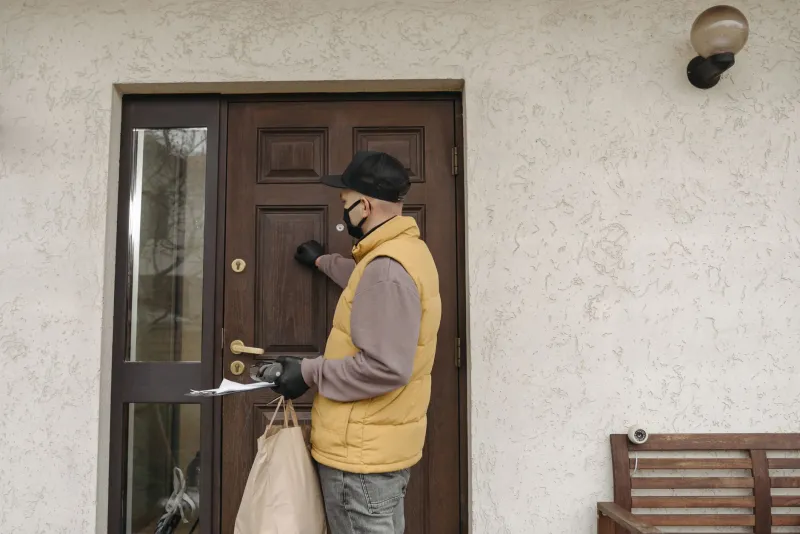
But there is another constituency in this story — one that has no say in whether they are recorded, no access to the footage, and almost no legal recourse when that footage is misused. They are the people whose jobs require them to walk up to your door dozens, sometimes hundreds, of times each day.
The Invisible Workforce on Camera
Consider the scope. The United States Postal Service delivers to roughly 167 million addresses. UPS and FedEx together employ hundreds of thousands of drivers. Amazon Logistics operates a sprawling network of independent delivery service partners. Add utility technicians, home health aides, plumbers, and landscapers, and the picture becomes clear: a significant portion of the American workforce spends its day moving in and out of the capture zones of privately owned surveillance cameras.
Unlike employees monitored in a warehouse or office — environments where labor law and employer policy at least nominally govern recording practices — workers who approach private residences exist in a largely unregulated space. They have not consented to being filmed. In most cases, they are never informed that footage of them is being stored, shared, or reviewed.
"From a legal standpoint, the homeowner's property rights generally dominate," says one privacy attorney who advises gig-economy workers in California. "If you walk up to someone's front door, you are in a space where recording is almost universally permitted. The fact that it's your job doesn't change that calculus in most states."
What the Law Actually Covers — and What It Doesn't
Federal law is largely silent on the specific question of recording people who approach private residences. The Fourth Amendment protects citizens from government surveillance, not private recording. The Electronic Communications Privacy Act governs wiretapping and audio interception but has limited application to video recorded in publicly observable spaces like a front porch or driveway.
State law introduces some variation. Illinois, California, and a handful of other states have broader biometric privacy statutes that could theoretically apply when doorbell cameras use facial recognition features — a capability that some third-party apps now offer as an add-on to standard systems. Illinois' Biometric Information Privacy Act, for instance, requires informed consent before collecting facial geometry data. Whether a doorbell camera passively capturing a delivery worker's face constitutes a BIPA violation remains an active legal question.
For the most part, however, the answer to "Can my neighbor's Ring camera record me every day as I do my job?" is yes, with minimal restriction.
Documented Misuse: From Harassment to Termination
The absence of legal guardrails has enabled a range of documented abuses. Nextdoor and neighborhood Facebook groups have become informal repositories for doorbell footage of delivery workers, often posted with suspicion-laden captions that can damage workers' reputations without due process. In several documented cases, drivers have been terminated after homeowners submitted doorbell footage to their employers — footage that, when reviewed in context, depicted nothing more than standard handling procedures misinterpreted by an untrained viewer.
More troubling are cases involving targeted harassment. Worker advocacy organizations have reported instances in which doorbell footage was used to track the schedules of specific drivers, enabling confrontations or complaints designed to get workers removed from routes. Because the footage is owned by the homeowner and typically stored on a company's cloud infrastructure, the worker has no right to view, contest, or request deletion of recordings that depict them.
Amazon's Neighbors app — Ring's community-sharing platform — allows homeowners to share footage with local law enforcement and neighbors simultaneously. Civil liberties organizations including the ACLU have raised sustained objections to this architecture, arguing that it creates an informal surveillance network with no accountability structure for the workers who appear in it most frequently.
What Homeowners Should Understand
This is not an argument against residential security cameras. Documented evidence of package theft, trespassing, and property damage demonstrates genuine utility. But homeowners who operate these systems carry responsibilities that the marketing materials rarely mention.
First, placement matters. Cameras angled to capture public sidewalks or neighboring properties introduce legal exposure in some jurisdictions. Devices positioned to record audio — Ring cameras include microphones active by default — may implicate state wiretapping statutes that require two-party consent, particularly in states like California, Florida, and Washington.
Second, data retention policies deserve scrutiny. Most major platforms store footage on cloud servers, and the terms of service governing that data are extensive. Homeowners who assume their footage is private should review what access their provider retains, what law enforcement request processes exist, and how long recordings are held.
Third, the ethical dimension is worth considering independently of the legal one. Workers approaching your home are, in most cases, performing a service you requested. Treating their image as data to be retained, shared, or submitted to their employer as evidence of misconduct — without the context a worker could provide — carries real human consequences.
A Framework Worth Advocating For
Several labor advocacy groups and digital rights organizations have proposed modest reforms: mandatory disclosure signage when residential cameras are active near public walkways, worker rights to request deletion of footage in which they appear, and clearer standards for when doorbell footage may be submitted to employers or law enforcement.
None of these proposals has achieved legislative traction at the federal level. Some states are beginning to examine the question more carefully, but the pace of policy development lags significantly behind the pace of device deployment.
In the meantime, the footage accumulates. Every shift, every route, every front porch. The workers who keep American commerce moving are being recorded more comprehensively than most of them realize — by cameras they did not choose, on servers they cannot access, under terms they were never asked to accept.
Understanding that reality is the first step toward addressing it.