Exposed in the Locker Room: How Hidden Cameras Found a Foothold Inside America's Fitness Facilities

Exposed in the Locker Room: How Hidden Cameras Found a Foothold Inside America's Fitness Facilities
When you swipe your membership card at the front desk of your local gym, you are consenting to a workout—not to being filmed. Yet for a growing number of Americans, the privacy they assumed was guaranteed inside a locker room has turned out to be an illusion. Hidden cameras, planted in some of the most intimate spaces imaginable, have been discovered at fitness chains, independent studios, university recreation centers, and hotel gyms from coast to coast. The problem is not theoretical. It is documented, recurring, and deeply underreported.
A Pattern That Extends Far Beyond Isolated Incidents
A review of criminal court records and law enforcement press releases from the past five years reveals a troubling frequency. In 2022, a personal trainer at a suburban Chicago fitness studio was arrested after investigators found a recording device concealed inside a gym bag hook mounted near a private shower stall. In 2021, a facilities employee at a Pacific Northwest gym chain was charged after a small pinhole camera was discovered embedded in a ceiling tile above a changing bench. In 2023, a university recreation center in the Southeast suspended operations in its locker room after a student found what appeared to be a modified smoke detector containing an active recording module.
These are not anomalies. The FBI's Internet Crime Complaint Center and state-level voyeurism task forces have noted consistent year-over-year increases in complaints involving covert recording in semi-private spaces, with fitness facilities ranking among the most commonly cited environments. Investigators attribute this partly to the nature of the space: high foot traffic, routine undress, and an ingrained social trust that most people extend to a place they visit multiple times per week.
Why Fitness Facilities Are Particularly Vulnerable
The architecture of a gym locker room creates a near-perfect environment for covert surveillance. Consider the density of legitimate objects already present in these spaces: wall-mounted soap dispensers, ventilation grilles, electrical outlets, combination lock panels, coat hooks, and overhead lighting fixtures. Each of these objects can serve as a convincing housing for a miniaturized recording device. Modern spy cameras are commercially available in form factors that mirror all of these fixtures with disturbing accuracy.
Beyond physical concealment, fitness facilities present an access problem. Many gyms outsource cleaning, maintenance, and construction to third-party contractors, creating a revolving door of individuals with legitimate reasons to be in restricted areas. Internal employees, particularly those working overnight shifts or in facilities management roles, often operate in locker rooms without supervision. Unlike a hotel room—which is sealed between guests and inspected by housekeeping—a gym locker room is a continuously occupied, semi-public space that receives inconsistent oversight.
Private training studios and boutique fitness concepts introduce additional vulnerabilities. These smaller operations may lack the institutional security infrastructure of a large chain, and their more intimate environments—where clients may change clothing or receive bodywork—can feel deceptively safe while offering fewer structural protections.
What the Law Actually Says—and Where It Fails
Federal law provides a baseline through 18 U.S.C. § 1801, the Video Voyeurism Prevention Act, which criminalizes intentional capture of images of a person's private areas without consent in circumstances where privacy is reasonably expected. However, this statute applies exclusively to federal lands and federal jurisdiction. The practical burden of prosecution falls almost entirely on state law, and the patchwork that results is deeply uneven.
As of 2024, all fifty states have some form of voyeurism statute on the books. But the specific language matters enormously. States including California, Texas, and New York have relatively expansive statutes that cover video recording in spaces where nudity or partial nudity is reasonably expected. Other states still rely on older statutory language that requires proof of physical trespass or that the recording was made for purposes of sexual gratification—standards that can be difficult to establish in court and that defense attorneys exploit with some success.
Perhaps more significantly, civil remedies for victims remain inconsistent. While criminal prosecution may result in a conviction, the financial and reputational consequences for fitness facility operators are frequently minimal unless the victim pursues independent civil litigation. Class action suits have been filed in several high-profile cases, but the legal threshold for establishing institutional negligence—as opposed to individual wrongdoing—remains a contested area across jurisdictions.
Gym-goers should not assume that a posted privacy policy or a laminated sign near the locker room entrance constitutes meaningful legal protection. These notices address data privacy in the digital sense; they do not create enforceable obligations regarding physical surveillance infrastructure.
Practical Detection Strategies for Gym Members
The first line of defense is behavioral awareness. Before undressing in any gym locker room, allocate sixty to ninety seconds to a deliberate visual sweep of the space. Focus on objects that appear out of place, particularly anything recently installed, covered in a thin layer of dust inconsistent with its surroundings, or positioned with an unobstructed line of sight toward changing areas or shower stalls.
Specific fixtures warrant heightened scrutiny. Wall hooks, particularly those mounted at mid-body height, are a documented concealment method. Smoke detectors and carbon monoxide sensors located directly above benches or changing stations deserve close examination—legitimate detectors are typically mounted near the ceiling center of a room, not positioned over specific user areas. Electrical outlets with unusually thick faceplates or small apertures near the center may house recording modules.
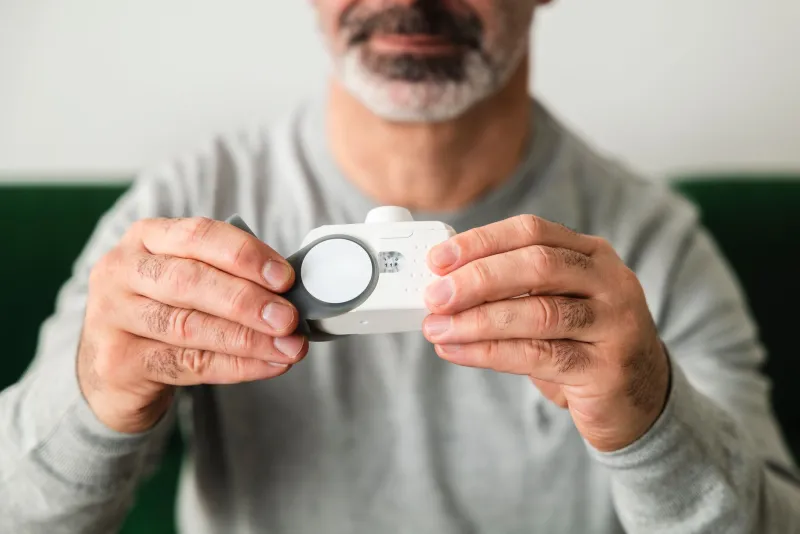
For members who frequent a gym regularly, a radio frequency (RF) detector is a practical investment. These handheld devices scan for the wireless transmission signals emitted by Wi-Fi or cellular-connected cameras. While they will not detect cameras recording to local storage only, the majority of devices encountered in documented gym cases have been network-connected. Lens detection tools, which use reflected infrared light to identify camera optics, provide a complementary layer of detection that is not dependent on signal emission.
If you identify a suspicious object, do not touch or move it. Photograph it from a distance using your phone, exit the area, and report immediately to facility management and local law enforcement. Preserving the chain of evidence is critical to any subsequent prosecution.
What Fitness Facilities Should Be Doing—But Often Aren't
Responsible gym operators have a professional and ethical obligation to conduct periodic sweeps of locker rooms and changing areas using detection equipment. Some larger chains have begun implementing formal protocols following high-profile incidents, but these policies are far from universal. Members are entitled to ask facility management directly whether such inspections occur, how frequently, and who performs them.
Installation of legitimate security cameras in locker room areas is, of course, legally prohibited in virtually all jurisdictions. However, the presence of a robust access control log—tracking who enters maintenance and storage areas adjacent to locker rooms—is a reasonable operational safeguard that conscientious operators should maintain.
The Reasonable Expectation You Are Owed
A gym membership entitles you to use equipment, access facilities, and occupy a locker room in a state of reasonable privacy. That expectation is not a courtesy—it is a legal standard recognized across the country, even if its enforcement remains imperfect. The documented prevalence of covert recording in these spaces does not mean surveillance is inevitable. It means that informed members, equipped with basic detection awareness and the right tools, are better positioned to identify threats before they become violations.
At StealCam, our position is straightforward: the burden of exposure should not fall on the person being watched. But until institutional accountability catches up with the scale of this problem, knowing how to look—and what to look for—remains your most reliable protection.