Checked In, Watched Out: What Every Business Traveler Must Know About Hotel Room Surveillance
The moment a hotel room door clicks shut behind you, most travelers assume a basic social contract has been honored: this space is yours, temporarily but genuinely. That assumption deserves scrutiny. Hidden cameras discovered in hotel rooms across the United States — in everything from budget motels along interstate corridors to four-star business properties in major cities — suggest that the threat is neither hypothetical nor rare. For business travelers carrying sensitive information, prototype devices, or confidential negotiations in their luggage and on their laptops, the stakes are considerably higher than they are for the average leisure guest.
This is not a piece about paranoia. It is a piece about preparation.
Why Hotels Are a Different Kind of Surveillance Risk
Most coverage of hidden camera threats focuses on short-term rental platforms, and for good reason — the decentralized, owner-operated nature of those properties creates obvious vulnerabilities. But hotels introduce a distinct threat profile that receives comparatively little attention.
First, consider access. A hotel room is entered by housekeeping staff, maintenance workers, and in some cases security personnel, often multiple times during a single stay. Each access event represents an opportunity for a device to be placed — or discovered and removed. Unlike a private Airbnb host who may install a camera before guests arrive and leave it in place, a hotel-based threat actor operates within a rotating workforce and institutional infrastructure that can either conceal or facilitate surveillance activity.
Second, business travelers are disproportionately targeted in what security professionals call "hotel room intelligence operations" — a practice documented by corporate espionage investigators and foreign intelligence agencies alike. The FBI has issued warnings to U.S. executives traveling internationally, but domestic hotel stays are not immune. A competitor seeking early access to merger discussions, a foreign national with business interests, or even a disgruntled employee with hospitality-industry connections can leverage hotel access in ways that are difficult to trace.
Third, hotels maintain their own legitimate surveillance infrastructure — corridor cameras, lobby systems, elevator feeds — that occasionally captures more than management acknowledges. While these systems are generally disclosed through posted signage and terms of service, the line between lawful monitoring of common areas and unlawful intrusion into private rooms is not always enforced with the rigor guests might expect.
The Legal Patchwork: What Is Actually Prohibited?
Federal law provides a baseline. The Video Voyeurism Prevention Act of 2004 makes it a federal crime to capture images of a person's private areas without consent in any location where there is a reasonable expectation of privacy — including hotel rooms. However, federal jurisdiction typically applies in federal facilities or when interstate commerce is demonstrably implicated. For most hotel surveillance cases, prosecution falls to state law.
Here is where the picture becomes complicated. State statutes vary significantly in scope, terminology, and enforcement priority. California's Penal Code Section 647(j) offers relatively robust protections, criminalizing the use of any device to view or record individuals in private spaces without consent. Texas, Florida, and New York maintain similar prohibitions, though the specific thresholds for criminal versus civil liability differ. Several states still operate under older voyeurism statutes that were written before miniaturized wireless cameras existed and have not been updated to reflect current technology.
For the business traveler, the practical implication is this: even if a hidden camera is discovered in your hotel room, the legal remedy available to you depends heavily on the state you are in, the nature of the footage captured, and whether law enforcement treats the matter as a priority. Civil litigation is possible but slow. Criminal prosecution is inconsistent. Documentation at the time of discovery is therefore essential.
Detection Techniques That Work in Hotel Environments
The physical characteristics of hotel rooms — standardized furniture, consistent fixture placement, limited personalization — actually make anomaly detection somewhat more systematic than in a private residence. A trained eye can move through a room methodically.
Radio Frequency Scanning Wireless cameras transmit signals. A quality RF detector, operated slowly around the room with particular attention to areas facing the bed, bathroom door, and desk, can identify active transmission sources that do not correspond to known devices like the television or room thermostat. Note that many modern covert cameras use Wi-Fi rather than dedicated RF frequencies, so a detector that covers the 2.4 GHz and 5 GHz bands is preferable to older analog-only models.
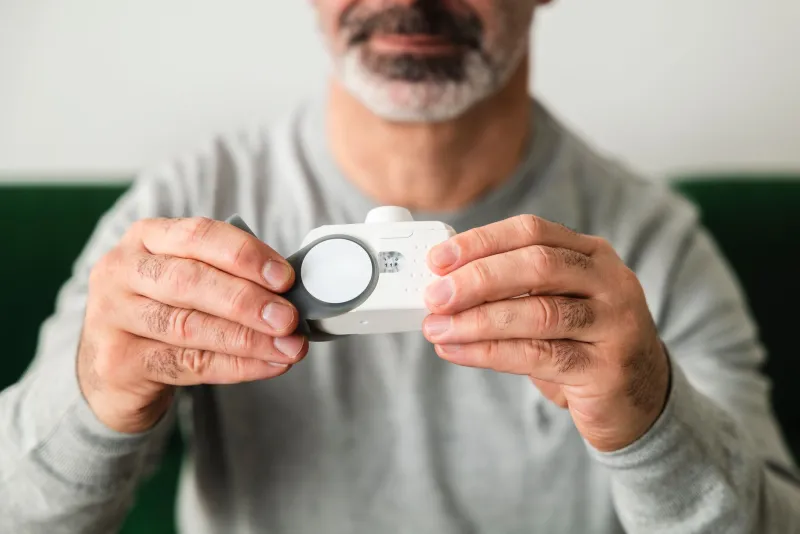
Lens Detection Camera lenses reflect light in a distinctive way. Dedicated lens-detection devices emit a focused beam and alert the user when a reflection consistent with a camera optic is returned. In a darkened hotel room, a smartphone with a lens-detection app can provide a rudimentary version of this scan, though purpose-built hardware is considerably more reliable. Move the detector slowly across smoke detectors, clock radios, air purifiers, wall outlets, picture frames, and any object positioned with a sightline toward sleeping or changing areas.
Physical Inspection No technology replaces methodical hands-on examination. Check smoke detectors for unusual weight or secondary holes. Examine wall clocks for lens apertures. Inspect USB charging hubs, which have become a common concealment device. Look behind mirror frames and inside any decorative object that seems out of place relative to the room's standard furnishings. In extended-stay properties, where guests may leave personal items between visits, pay particular attention to anything that was not present on a previous stay.
Network Scanning For travelers with moderate technical comfort, scanning the hotel's Wi-Fi network for connected devices can reveal cameras operating on that network. Applications such as Fing allow a user to enumerate devices visible on the local network. An unfamiliar device with a camera-associated manufacturer ID — brands such as Hikvision, Dahua, or Wyze appearing on a hotel network in proximity to your room — warrants further investigation.
The Pre-Sleep Privacy Checklist
The following checklist is designed to be completed in under ten minutes upon entering a new hotel room. It does not require specialized equipment for the basic version, though a dedicated RF and lens detector will meaningfully improve detection probability.
- Conduct a visual sweep before unpacking. First impressions matter. Note any object that appears inconsistent with the room's standard layout or shows signs of recent disturbance.
- Examine all smoke detectors. Remove and inspect if the unit appears heavier than expected or has apertures beyond the standard sensor vents.
- Check the television. Smart TVs in hotel rooms can carry cameras or microphones. Cover the bezel area around the screen with a towel or clothing when not in use.
- Inspect USB ports and charging devices. Do not use USB charging hubs provided by the hotel unless you have verified their integrity. Bring your own charger.
- Scan with an RF detector if available. Cover the room systematically, moving at approximately one foot per second.
- Perform a lens-reflection check. Darken the room and use a lens detector or flashlight-assisted smartphone scan across all surfaces with sightlines to private areas.
- Cover or disable the laptop camera. A physical camera cover is inexpensive and eliminates one vector entirely.
- Note the room number and photograph any suspicious device. If you discover something concerning, document it before touching it, notify hotel management in writing, and contact local law enforcement.
- Request a room change if anything feels wrong. You are not obligated to remain in a room that raises legitimate concerns.
Final Consideration
The business traveler who carries a laptop containing acquisition strategy, personnel records, or unreleased product specifications is carrying information that has genuine monetary value to the right audience. Treating hotel room privacy as a professional security concern — rather than an abstract personal one — is not excessive caution. It is risk management. The tools and habits described here require modest investment and a few additional minutes per stay. Measured against the potential cost of a compromised negotiation or a leaked prototype, that investment is difficult to argue against.